 Charades
Charades for Large Groups: Team Setups That Actually Work
How to run charades for 10, 20 or 50 people without half the room going quiet — team sizes, scoring formats and the variations built for a crowd.
4 min read
Charades breaks down at about twelve people. Not because the game is wrong, but because the default format gives one person something to do and everybody else something to watch. With twenty people, each player acts roughly once an hour.
The fix is structural. Below are the formats that keep a large room playing, ranked by how big the group is.
The core problem with a big room
In standard charades, one actor performs and everybody guesses. That scales badly in two directions at once: turns get rarer as the group grows, and guessing gets less satisfying because the loudest three people get there first.
Every format below solves this by running more than one thing at a time, or by making the guessing a team job rather than a free-for-all.
10 to 15 people: two teams, rotating actors
The classic setup, and it holds up to about fifteen.
Split into two teams. Teams alternate turns. Within a team, the actor rotates every turn so nobody performs twice before everybody has performed once. Only the actor's own team may guess — this is the important part, because it stops the confident people on the other side of the room from stealing rounds.
Score one point per correct word inside the timer. First team to twenty-five points wins, or play a fixed number of rounds if you want a predictable finish.
15 to 25 people: three or four smaller teams
Two teams of twelve is worse than four teams of six. Smaller teams mean each person acts four times as often and everybody is close enough to the actor to actually see.
Run teams in sequence: team A acts, then B, then C, then D. It sounds slow but each turn is only sixty seconds, so a full cycle takes four minutes and every player is involved in a quarter of them.
If you have the space, run two games in parallel in different rooms and combine the scores at the end. Two games of ten beat one game of twenty every time.
25 or more: relay charades
For a genuinely large crowd, switch format entirely.
Line each team up. The first person sees the word and acts it for the second person only — no guessing aloud. The second acts what they think they saw for the third, and so on down the line. The last person says the answer out loud.
The comedy is in the drift. "Brushing your teeth" becomes "playing a trumpet" by person five. Score a point if the final answer matches, but nobody plays this for the points.
Relay works with any number, needs no equipment beyond a phone with the word on it, and everybody in the line has a job.
Other formats for a crowd
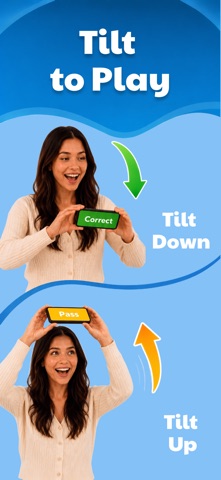
Headbands. Instead of acting, the player holds the phone to their forehead and the whole room shouts clues. This inverts the problem completely: one person is quiet and everybody else is loud, which is exactly what a big room wants. The app runs this hands-free — tilt down for correct, up to pass.
Speed round. One actor, one minute, as many words as possible, whole room guessing. Use it as an opener to warm up a crowd before splitting into teams.
Pairs tournament. Pair everybody up. Each pair gets sixty seconds. Highest score after one full pass through all pairs wins. Good for a party where people are drifting in and out, because a late arrival just joins the next pair.
Practical things that matter more than the format
Make the actor stand somewhere visible. In a big room this is the single biggest fix. A doorway or in front of a fireplace, not in the middle of a sofa.
Use a phone, not paper slips. With twenty people, whoever holds the list cannot play and someone always reads ahead. A generator removes the job entirely.
Keep the timer visible to everyone. Half the tension of charades is the clock, and a crowd cannot see a wristwatch.
Cap passes at one. In a large group, passing is contagious. One person burns their turn hunting for an easy word and the next actor does the same.
Pick packs everybody shares. A film pack fails if a third of the room has not seen the films. Act It Out and Funny need no shared reference at all, which is why they work best for mixed crowds.
The general rules are in how to play charades.
Which packs suit a crowd
- Act It Out charades — 143 situations, no shared knowledge required
- Funny charades — 97 words that read from across a room
- Easy charades — 106 words for a group with mixed ages
- Christmas charades — 83 words when the crowd is a family gathering
- Party packs — everything built for volume
Or open the charades generator, put the phone somewhere everyone can see, and start.
Play a round right now
Pick any of 90 word packs, set the timer, and act it out. Free, no signup.